
From Super-Doer to Sustainable Leader: The Wellbeing Case for Delegation
By Paige Edwards-Werhan
In the specialized world of higher education, many of us are promoted because we are exceptional “doers” — the researchers who win the grants, the clinicians who master the complex cases, or the administrators who keep the gears turning.
But there is a quiet irony in leadership: The technical expertise that earns you the office is often the biggest hurdle to actually running it. As the Association for Talent Development (ATD) notes, the hardest pivot for any new leader isn’t learning a new software; it’s resisting the “I’ll just do it myself” reflex and learning to leverage the brilliance of the team around you.
Beyond simple efficiency, this pivot is a requirement for wellbeing. Effective delegation transcends clearing your desk; it’s a fundamental skill that builds trust, fosters collaboration, and, most importantly, reclaims the mental bandwidth you need for strategic focus and personal balance.
To help you trade the doer hat for the leader hat without burning out, here are three frameworks synthesized from current professional development research.
1. Identify the What: The Eisenhower Decision Matrix
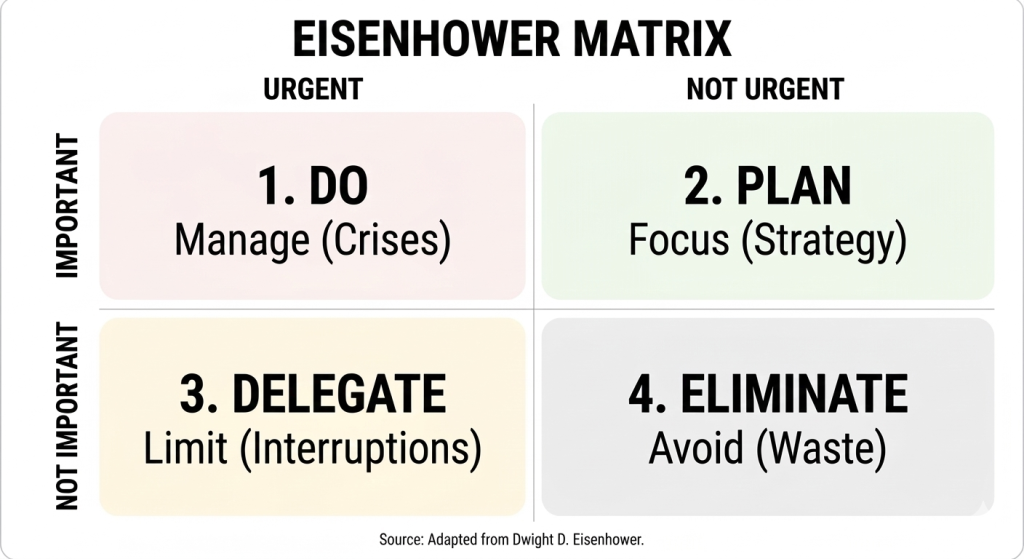
A common barrier to delegation is the inability to distinguish between a fire that needs your personal attention and a task that simply needs to be done. Constant crisis mode erodes resiliency. To audit your task list, we recommend the Eisenhower Decision Matrix, a strategic framework for prioritization popularized by Stephen Covey and based on the time-management habits of Dwight D. Eisenhower.
The matrix categorizes your work into four quadrants, providing a clear filter for what should stay on your plate and what should be handed off to maintain your equilibrium:
- Quadrant 1: Do (High Urgency / High Importance): Critical tasks that require your specific expertise (e.g., a grant deadline or a clinical emergency). Keep these.
- Quadrant 2: Schedule (Low Urgency / High Importance): Strategic work that moves your mission forward. This is where wellbeing lives — protecting time for vision and relationship-building. Protect these.
- Quadrant 3: Delegate (High Urgency / Low Importance): This is the “Delegation Zone.” These tasks feel urgent but do not require your expertise. Hand these off to reduce decision fatigue.
- Quadrant 4: Delete (Low Urgency / Low Importance): Activities that offer little value. Remove these to create space for recovery.
2. Overcome the Perfectionism Trap: The 70% Rule
To combat “Self-Enhancement Bias,” or the internal pressure to do everything perfectly, many leadership experts, including Jim Collins (Good to Great), advocate for the 70% Rule: If a team member can complete a task at 70% of your current competency, you should delegate it.
Resiliency is built in the gap between 70% and 100%. By allowing for a learning curve, you develop your staff’s confidence and free yourself from the “bottleneck effect,” where your own wellbeing is sacrificed because everything is waiting for your approval.
3. Set the How: The Delegation Ladder
Delegation is not a binary choice between micromanagement and total abdication. To navigate this middle ground and maintain a balanced workload, author and leadership expert Michael Hyatt defines Five Levels of Delegation. This framework allows you to match a task’s complexity to a team member’s readiness:
- Investigate: “Research this topic and report back with the facts; I will decide.”
- Inform: “Research the options, including the pros and cons; I will decide.”
- Recommend: “Research the options and give me your recommendation; if I agree, I’ll give the go-ahead.”
- Act: “Decide and take action, but let me know immediately what you did.”
- Own: “Handle the task entirely. You have my full confidence.”
Pro-Tip: Stop the “Returning Monkey”
In the Harvard Business Review classic, William Oncken Jr. and Donald L. Wass warn against “reverse delegation” — when a task (the “monkey”) leaps off a staff member’s back and onto yours the moment they hit a roadblock.
To protect your time and foster collaborative resiliency, resist the “rescuer impulse.” When a team member asks for a solution, pivot from answering to coaching with questions like:
- “What options have you already considered?”
- “What would your next step be if I weren’t available?”
- “What data do you need to make this call?”
Keeping the “monkey” with its rightful owner ensures that your team grows and your own wellbeing remains intact.
Continue your professional development with HRLD:
- Register for HRLD in Person: Practical Tactics for Effective Delegation, an in-person workshop at 1:30 p.m. on Tuesday, March 17.
- Schedule time for Delegation Strategies for People Leaders, an on-demand Workday Learning course.
- Register for the three-session workshop series HRLD in Person: ResilientWake Spring 2026, offered in conjunction by the Office of Wellbeing and Learning and Development.
- Visit HRLD online.
- Contact the HRLD team.